
Extrusion crossheads
Fixed centre, manual centre and in-line heads for wire, cable and tube extrusion, made in-house with tooling concentric to 0.01 mm.
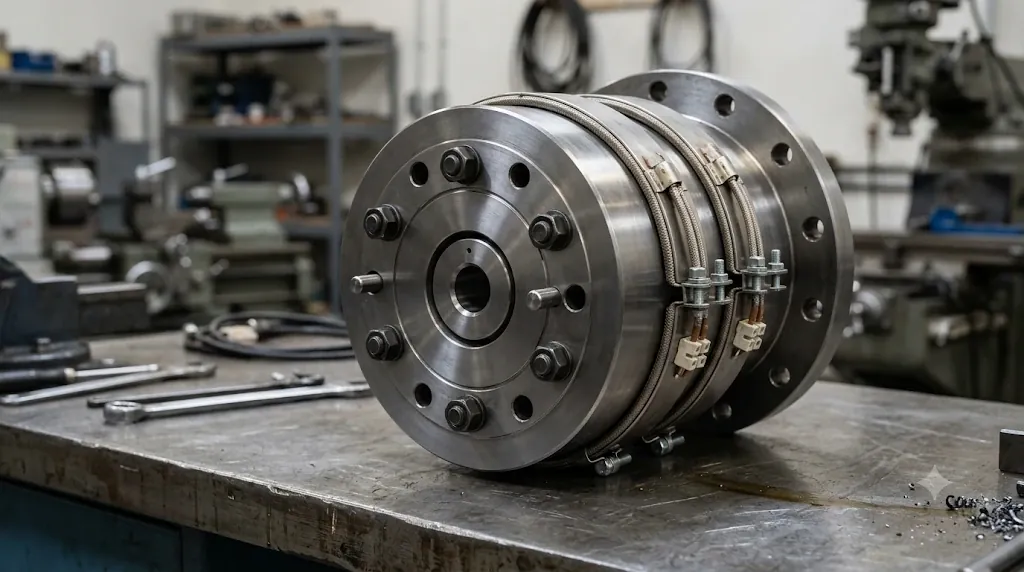
A cable extrusion crosshead with its band heaters fitted.
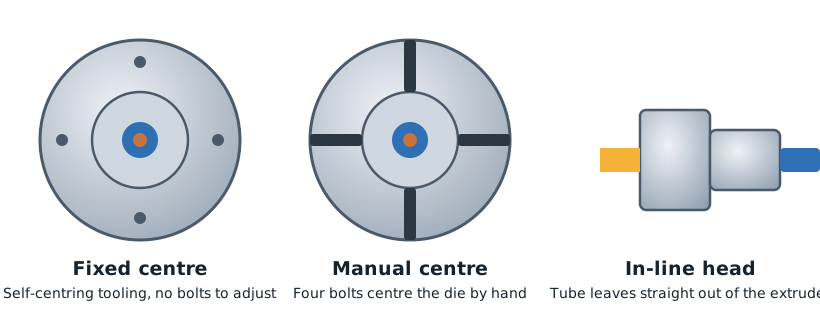
The three head families. Fixed centre heads need no centring; manual centre heads are set with four bolts; in-line heads keep the product in line with the extruder.
How to read a crosshead size
Sai crossheads are named by two numbers. The first is the largest conductor or tip size the head accepts, in millimetres. The second is the largest finished cable or die size. So a 16/20 head handles conductors up to 16 mm and finished cable up to 20 mm across. Choose the smallest head that covers your largest product: an oversized head holds more melt, takes longer to purge and is harder to keep stable on small sizes.
Fixed centre crossheads
The tip and die locate on precision-ground diameters, so the tooling is centred by the head itself. Changing sizes is fast and the result does not depend on how the operator sets the bolts, which makes fixed centre heads the usual choice for high-volume building wire and LT cable.
- 4/6
- 8/14
- 15/18
- 16/20
- 25/35
- 35/45
- 50/70
Triple-layer versions are available in 4/6, 16/20 and 35/45.
Manual centre crossheads
Four adjusting bolts move the die to centre the wall. That gives the operator direct control, useful for larger cables, jacketing and lines that run many different products.
- 6/10
- 10/20
- 20/30
- 35/45
- 40/60
- 60/80
- 80/100
- 100/120
- 120/140
Skin and strip versions are available across the manual centre range.
In-line heads
For tubes, hoses and some jacketing, the product leaves in line with the extruder instead of turning through 90 degrees.
| Model | Maximum tube diameter |
|---|---|
| Sai-In-6 | 6 mm |
| Sai-In-15 | 15 mm |
| Sai-In-25 | 25 mm |
Single, skin, strip and triple-layer heads
| Layer type | What it does | Typical use |
|---|---|---|
| Single layer | One layer of insulation or sheath | Building wire, LT power cable cores, jackets |
| Skin layer | A thin second layer over the main insulation, from a second extruder | Colour skins, foam-skin and dual-layer insulation |
| Strip | A coloured identification stripe on the surface | Core identification |
| Triple layer | Three layers in one pass | Multi-layer insulation systems |
What makes a head hold concentricity
- Precise location of tip and die. Tooling in Sai heads is made to a concentricity of 0.01 mm.
- Balanced flow channels. Melt must arrive evenly all round the tip. Uneven flow pushes the wall to one side, whatever the bolts say.
- No dead spots. Stagnant melt degrades and shows up as black specks and spark-test faults.
- Even heating. A cold side in the head changes the melt viscosity and the wall with it.
For more on measuring the result, see this guide to concentricity in cable insulation.
Choosing a crosshead
- List your conductor and finished cable sizes; the largest sets the head size.
- Decide on layers: single, skin, strip or triple.
- Pick fixed centre for fast, repeatable changeovers, or manual centre for large or varied products.
- Send your extruder make, screw size and mounting so the head fits first time.
Ask for a crosshead quotation
Tell us the cable sizes, compound, number of layers and your extruder. Drawings of an existing head are welcome.
Frequently asked questions
What does a crosshead size like 8/14 mean?
The first number is the largest conductor (tip) size the head takes in millimetres, and the second is the largest finished cable (die) size. An 8/14 head runs conductors up to 8 mm and cable up to 14 mm outside diameter.
What is the difference between a fixed centre and a manual centre crosshead?
In a fixed centre head the tooling centres itself, so there are no bolts to adjust and size changes are quick and repeatable. In a manual centre head the operator centres the die with adjusting bolts, which gives direct control but depends more on operator skill.
How concentric is a Sai crosshead?
Tooling in Sai crossheads is made to a concentricity of 0.01 mm, so the insulation wall stays even around the conductor when the head is set up correctly.
Can a new crosshead be fitted to my existing extruder?
Usually yes. Tell us the extruder make, screw size and the existing mounting, or send a drawing, so the head and its mounting can be matched.